America’s first hospitality brand was girl-powered
You have it tough sometimes, no doubt about that. But what if…you had only scant minutes to cater a full meal to several hundred weary, most likely grumpy men, plus women and children? Oh, and what if your kitchen had no refrigeration? Little fresh produce. And no Sysco or any other restaurant supplier to restock anything?
You’ve heard of mystery meat? Yep, that was always on the menu.
The American West of the 1870s was as far as can be imagined from a five-star hospitality experience, especially along the new railroad lines that replaced the wagon train trails. There were no dining cars in those territories yet. Locomotives needed to stop every 100 miles to take on fresh water for their steam engines, and there, usually in the middle of nowhere, passengers disgorged to the so-called restaurant that sat next to the water tank. They had to prepay for the meal. It was a common suspicion that plates were scraped of “reusable” food for the next disgorging of diners.
Rowdiness was not uncommon. Dissatisfaction was rampant.
The New York Times bemoaned the horrid reality of eating and drinking at these railroad stations thusly: “It is expected that [passengers] can be whirled half a day over a dusty road, with hot cinders flying in their faces, and then when they approach a station and are dying of weariness, hunger and thirst, longing for an opportunity to bathe their faces at least before partaking of their much-needed refreshments, that they shall rush helter-skelter into a dismal long room.”
One man transformed all this. Along with, over the course of his enterprise, some 100,000 women.
His name was Fred Harvey. The women were known as Harvey Girls, who became so famous Judy Garland starred in a movie musical about them. Together, Harvey and his highly trained, immaculately attired, impeccably mannered female staff created the nation’s first hospitality brand.
This is their story.
A Tailor’s Son in the Gilded Age

Fred Harvey was the son of an English tailor. He immigrated to the United States in 1853, at age 17, where he got a job as a pot scrubber and busboy at a popular eatery in New York City and then worked at a fine-dining restaurant in New Orleans. In his early forties, he launched a revolutionary business feeding train passengers in the Wild West along the Santa Fe Railway—civilized food served in civilized settings by skilled servers.
At its peak, the company he founded, according to biographer Stephen Fried in Appetite for America, had over 65 restaurants and lunch counters, a dozen large hotels, 60 dining cars, all the restaurants and retail shops in five of the nation’s largest railroad stations, and “so many newsstands and bookshops that its prepublication orders regularly affected national best-seller lists.”
Read More: Travel and Experience by Train
Fried continues: “While he died famous and wealthy, he was also a curiosity—a man out of time—because at the height of the Gilded Age, he became something much better understood today: the founding father of the American service industry. That’s why his story and methods are still studied in graduate schools of hotel, restaurant and personnel management, advertising, and marketing. He is especially popular in the buzzwordy fields of ‘branding’ and ‘brand extension,’ because ‘Fred Harvey’ was actually the first widely known and respected brand name in America, established years before Coca-Cola.”
Even though little known today outside of these classrooms, Harvey’s place in the history of American hospitality cannot be overstated. Fried proclaims that Fred Harvey was Ray Kroc before McDonald’s, Howard Johnson before Hojo’s, J.W. Marriott before Marriott hotels. He might have added he was also Conrad Hilton before Hilton hotels and Jay Pritzker before Hyatt.
His enduring impact didn’t end there. He and his partners at the Santa Fe Railway played a huge role in the development of American tourism as we know it—in particular, the promotion of “the mythic Southwest and what grew into the National Park System,” Fried says. What became known as “Santa Fe style” was invented at Harvey’s direction.
“Fred Harvey was Ray Kroc before McDonald’s, Howard Johnson before Hojo’s, J.W. Marriott before Marriott hotels.”
“Fred Harvey was also the most important driving force in the early appreciation and preservation—and, to some, exploitation—of Native American arts and culture. Most of the Indian art and crafts now on display in the world’s major museums were originally owned by Fred Harvey. And much of the silver and turquoise jewelry that we think of as Indigenous was commissioned and, in some cases, even designed by the Fred Harvey company to sell in its myriad gift shops.”
As Fried concludes, “The restaurants and hotels run by this transplanted Londoner and [later] his son did more than just revolutionize American dining and service. They became a driving force in helping the United States shed its envy of European society and begin to appreciate and even romanticize its own culture.”
The Girls Behind the Man

And he couldn’t have done all this without the Harvey Girls.
How they came about is a story in itself. Harvey had already established a number of railroad “eating houses” in New Mexico and Kansas and was reaping accolades for them, but not only was the West still a haven for robbers and thugs of various stripes, many cowboys were former Confederate soldiers. His waiters and busboys, as in most Western restaurants at that time, were Black men. Inevitably, violence and worse were on the menu.
Read More: A Network to Amplify Women’s Influence
The experiment began at his eating house in tiny Raton, New Mexico, where there had been trouble. Harvey agreed to let his manager replace the male waiters with women. “And that,” the manager later recounted, “is how I brought civilization to New Mexico. Those waitresses were the first respectable women the cowboys and miners had ever seen—that is, outside of their own wives and mothers. Those roughnecks learned manners!”
Harvey quickly adopted the Raton model for his entire eating house chain. As biographer Fried points out, this decision in 1883 was “a crucial turning point for American women.” Outside of nursing, the country’s only other major female workforce of note had been as mill workers in Massachusetts, but they “were often exploited, and never had anything like the kind of freedom and empowerment that came from leaving home and reinventing themselves in a new place.”
It was, in a word, revolutionary. And not unlike joining a quasi-religious order or attending a highly disciplined boarding school in its rules and oversight.
In the beginning, Harvey offered young women $17.50 a month, plus tips. Not bad for the time, especially since he also provided free room, board and transportation. Those who answered newspaper ads in Kansas and elsewhere in the Midwest for applicants aged 18 to 30 with at least an eighth-grade education and “good morals and good manners” had to sign a six-month contract and stay single. They shared a dormitory attached to the hotel and were chaperoned by a live-in female. Lights-out was at 11 o’clock sharp.
All Harvey Girls wore uniforms on duty. The first version was a long-sleeved, black woolen dress with a white collar, black shoes and stockings. A starched white apron spanned neck to ankle. Makeup was an absolute no-no—and carefully monitored.
The skirt was supposed to hang no more than 8 inches off the floor, but Harvey alumnae remember that the younger girls tried to get away with shortening theirs by pinning their dresses up a little higher.
There was a “Fred Harvey way” for everything. Lists of “fundamentals” like “have a sincere interest in people” and “real service is without discrimination.” Rules posted in employee housing that read “loud talking and laughing in rooms and halls should be avoided” and “expectorating on floors is positively forbidden.”
You had to be thoroughly trained before you graduated to serve customers. “Mrs. Severenson trained me,” one former Harvey Girl told her local newspaper. “She was stern, but she trained you very, very well. It was real rigid training. Harvey Girls were clean—an elite group—respected and there was no dirty talk. You didn’t stand around talking. We were hard workers, and the dishes were immaculate.”
Yet despite the rigor and rules, the appeal of joining this corps of young women was clear.
Zada Sharon joined up in the 1930s. “The most important [thing] about being a Harvey Girl is the fact [that] it gave women a chance to move out of the lives they were locked into and be a little adventuresome,” she said in an oral history by the New Mexico History Museum. “Women were just trapped in the worlds that they lived in because they had no independence. Financial independence didn’t exist.”
Another Harvey Girl of that era, Irene Armstrong, who worked at a Harvey hotel in Gallup, New Mexico, called El Navajo, agreed. “Of course, it was unheard of, going so far away from home,” she said. “Most of those girls had never been away from home, and it was kind of scary.”
As a student of the history of the Harvey Girls, Johanna Lee observed, “He treated women with respect. He had rules, and they had to sign a contract, but he paid them a fair wage, and there was no humiliation.”
“The most important [thing] about being a Harvey Girl is the fact [that] it gave women a chance to move out of the lives they were locked into and be a little adventuresome.”
– former Harvey Girl
In the 1940s, Harvey’s repute spawned a best-selling novel, and then an Oscar-winning MGM musical called “The Harvey Girls” starring Judy Garland at the height of her career, which had the whole country singing along with her about the joys of exploring America “On the Atchison, Topeka and the Santa Fe.”
Harvey’s waitresses made hospitality history. And while doing so, many of them ended up marrying someone they met while pouring him coffee or serving him a meal. Marriageable women were scarce in the overly testosteroned West. As humorist Will Rogers once observed, the Harvey Girls “kept the West in food—and wives.”
The Woman Behind Harvey’s Grandest Hotels
The Harvey hotel many meeting profs may know is the celebrated El Tovar, perched majestically on the rim of the Grand Canyon. Envisioned as a Swiss chalet-meets-Norwegian villa, it was considered the most elegant hotel west of the Mississippi when it opened in 1905 and has since been designated a National Historic Landmark. Unquestionably, it has views to die for. Today it is operated by Xanterra, which acquired The Fred Harvey Company in 1968, and is now the nation’s largest national and state park concessionaire.
Most other Fred Harvey properties are only echoes in history, yet exceptions do endure—and several of these bear the unmistakable imprint of a woman who was never a Harvey Girl. Once again ahead of his time, Harvey’s favorite architect was Mary Elizabeth Jane Colter. She didn’t design El Tovar, but did create other magnificent Harvey structures at the Grand Canyon.
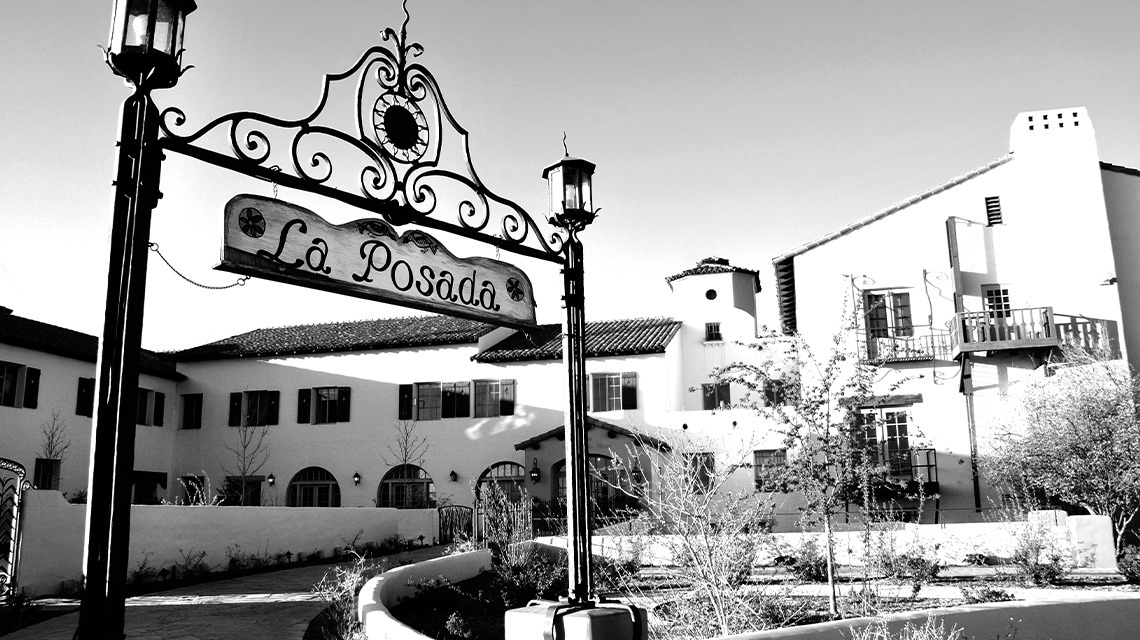
A Harvey resort in Winslow, Arizona, however, is considered her masterpiece. It’s La Posada, or “the resting place.”
Winslow is the Arizona headquarters town of the Santa Fe Railway, Harvey’s longtime partner, and a comfortable day’s drive to all the best sights in the northern part of that state. Harvey decided this resort should be the finest in the Southwest, with no expense spared. Colter was able to design or select everything from the structures to the landscape, furniture, maids’ uniforms and dinner china.
According to many accounts, Mary Colter began designing her buildings by imagining a fantasy about their history. She envisioned La Posada as the grand hacienda of a wealthy Spanish landowner whose family lived there for 120 years. This vision guided every aspect of her architectural design.
La Posada opened in May 1930, as the Great Depression changed the world, yet it survived and stayed open for 27 years, playing host to famous guests ranging from Albert Einstein to Clark Gable, Amelia Earhart to President Franklin D. Roosevelt. After a meticulous $12 million restoration, it reopened as a luxury resort under new ownership in 1997.